
What Hartford County Deed Records Show
A deed names its parties and the interest conveyed. That wording matters. Capacity can change the meaning, since a trustee, fiduciary, surviving owner, or business entity may sign in a role that plain buyer-seller labels miss.
| Deed Type | What It Does | Common Use |
|---|---|---|
| Warranty deed | Conveys the stated interest with deed covenants. | An ordinary arms-length transfer. |
| Quitclaim deed | Conveys whatever interest the grantor holds without the same covenants. | Correcting or rearranging an existing interest. |
| Executor or administrator deed | Transfers under estate authority. | A probate-related sale or distribution. |
| Certificate of foreclosure | Records the result of a foreclosure process affecting ownership. | Connecting a court matter to the land index. |
| Tax deed | Records a transfer arising from a completed tax-sale process. | Following delinquent-tax title events. |
Mortgages, releases, liens, easements, and lis pendens appear beside deeds in the land records. Not every one conveys ownership. The instrument type tells you what the name means.
There Is No Hartford County Recorder
Connecticut puts land records at the municipal level. Under Connecticut General Statutes chapter 92, the town or city clerk of each municipality handles these duties. The clerk receives instruments affecting real estate. The clerk also indexes them. A parcel inside Hartford belongs in Hartford SearchIQS. New Britain land records run through the New Britain Town Clerk's RecordHub route. West Hartford deeds stay with the West Hartford Town Clerk.
Pin down the municipality before you search. Use the assessor, the GIS map, or the legal description. ZIP labels are postal routes. A Hartford mailing address can sit on a parcel in East Hartford, West Hartford, Newington, Wethersfield, Bloomfield, or Windsor. The wrong index can return a convincing same-name result with no tie to your parcel.
Hartford SearchIQS Has Two Deed Eras
Hartford SearchIQS offers a guest route. Its published coverage separates ordinary land-record index data from document images, so check both before assuming images exist.
| Hartford collection | Coverage found | What is online |
|---|---|---|
| Ordinary land records | January 2, 1964 through December 27, 2001 | Index information only |
| Recent land records | December 28, 2001 to present | Index and images |
| Recorded maps | August 1, 1863 to present | Index and images |
| Condominium records | July 14, 2011 to present | Published category coverage |
| Foreclosure registrations | June 5, 2014 to present | Published category coverage |
Here is the mismatch. Hartford's online maps reach much earlier than its ordinary deed index, so a map dated before 1964 does not prove a grantor-grantee search covers that year.
View the Hartford Land-Record Entry Point
The official Hartford Town and City Clerk directs land-record researchers to SearchIQS.
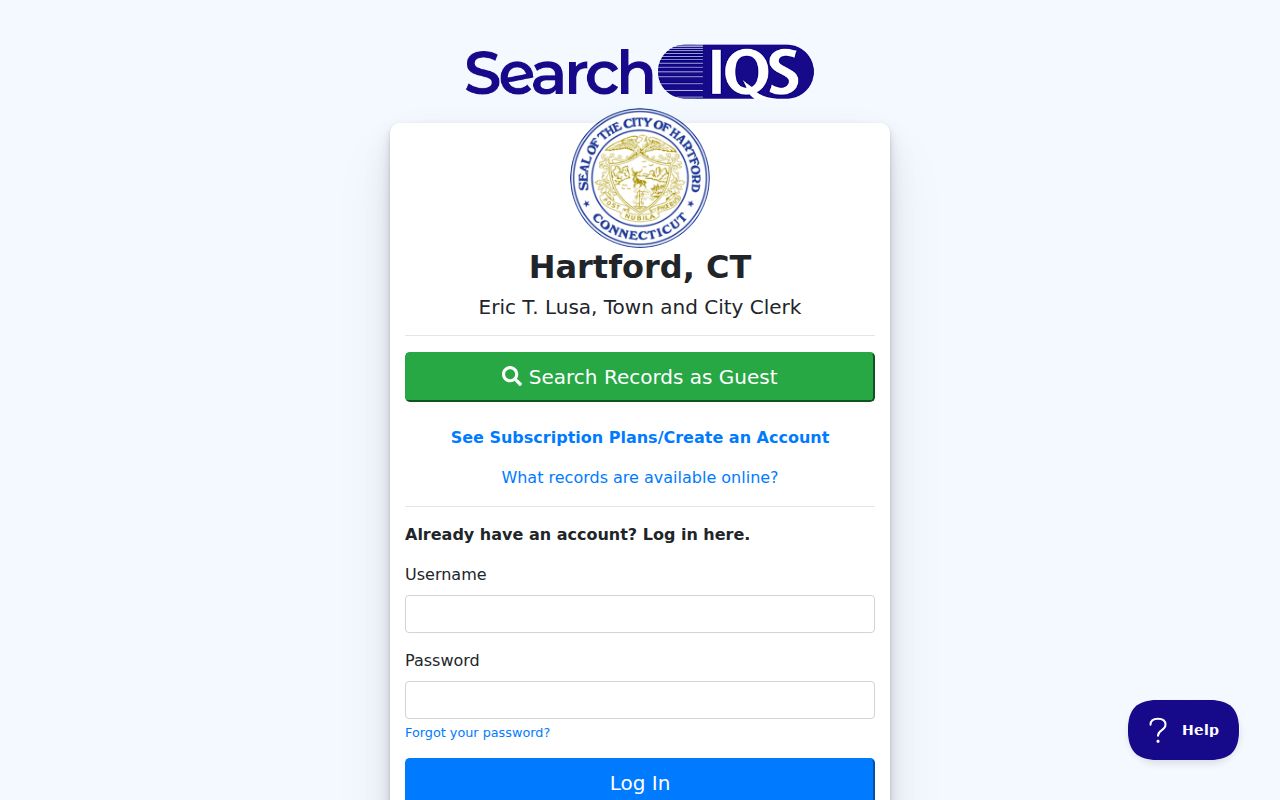
The landing page shows guest and account routes. Use it as the doorway to the index. Once inside, save the result row, recording reference, and image status for each instrument that matters.
New Britain Deeds Use RecordHub and HLR Volumes
The New Britain Town Clerk page points current deed research to RecordHub. Indexes and images run from October 1, 1958 forward. Older records fill historic volumes 1 through 54, covering 1850 through 1958. Those volumes are not a modern grantor-grantee index. Enter HLR, pick a volume, and load it. Then page through to the entry you need. Write down the volume and page before asking the clerk for a copy. The fallback is genuinely useful, though it demands more prior knowledge than a simple name search.
New Britain's July 2025 schedule lists recording charges of $70 for a first page and $5 for each additional page or portion, plus certain statutory additions. Those are recording fees. They do not price every certified copy. Confirm the current clerk schedule for your service.
Note: Legacy Connecticut Town Clerks subscription and image prices describe the older portal and should not be treated as current RecordHub charges.
Walk the Municipal Grantor-Grantee Index
Start from the latest owner of record or the legal reference on the assessment card. Log both dates. The instrument date and recording date often differ. At each step, confirm the legal description covers the whole parcel, not a partial interest, easement, condominium unit, or strip.
- Search the current owner as grantee and identify the deed that brought the interest in.
- Capture instrument type, dates, book/page or document number, grantor, grantee, image status, and legal reference.
- Search that deed's grantor as a grantee to locate the earlier acquisition.
- Repeat through spelling variants, entity changes, trustee or executor capacities, probate, and foreclosure events.
- At the online boundary, move to historic volumes, the clerk counter, municipal archives, or the State Library.
- Grantor
- The party conveying an interest.
- Grantee
- The party receiving that interest.
- Chain of title
- The ordered sequence of recorded title events tied to the same land.
- Book/page or instrument number
- A retrieval key for a recorded document, not an ownership conclusion by itself.
Search Beyond the Deed Type
A sound chain reaches past conveyances. Search mortgages and assignments to see which obligation a later release answers. Check mechanic's and tax liens along with their releases. Read easements, rights-of-way, restrictive covenants, boundary agreements, condominium declarations, and subdivision plans that burden or define the parcel.
A lis pendens flags pending litigation affecting title. A certificate of foreclosure records the finished court result. When a deed was executed by a fiduciary or follows litigation, cross-check the Connecticut civil case lookup or the Probate case lookup. The clerk's instrument remains the land-record source.
Maps Can Outlive the Name Index
Connecticut parcel histories often turn on a recorded map. Search widely. Look for subdivision, resubdivision, lot-line revision, boundary, right-of-way, survey, condominium, site-plan, and street-opening records, and note the title, date, preparer, recording stamp, sheet, lot numbers, easements, and prior references.
Hartford maps reach back to 1863 online. New Britain indexes clerk-retained maps with images. A subdivision mylar must carry the responsible professional's red live seal or stamp, and the planner decides whether a filing counts as a subdivision. Those local rules show why a current GIS outline cannot replace the approved, recorded plan.
Older Hartford County Title Clues
Online indexes stop eventually. For older deed books, map volumes, and public-terminal access, reach the clerk directly. The Hartford History Center serves as the official repository for Hartford City and Town Clerk archives. It safeguards nearly 400 years of government records plus maps and directories. The Connecticut State Library at 231 Capitol Avenue also helps. It holds Hartford County Superior Court indexes from 1836 through 1951 for historical court context.
Directories and Sanborn maps are useful leads. They can surface old street numbers or name variants, but they are not title evidence. Every archive clue should point back to its corresponding recorded instrument. That habit keeps a house-history search honest. It also stops a directory entry from becoming an unsupported ownership claim.
Get a Hartford County Deed Copy
A recorded image can answer most requests on the spot. When the municipality offers online coverage, pull the deed copy right from the land records index. If the image is missing, reach the same municipal clerk by phone, mail, or at the counter. Have the party names, instrument type, recording date, and book/page or document number ready. Hartford's public clerk number is 860-757-9749, and the official page explains a mailed-payment route when an image is unavailable. New Britain lists 860-826-3335, 860-826-3339, and 860-826-3345 for land-record help.
Ask the clerk whether a plain copy or a certified copy suits the purpose. Confirm the current cost and whether electronic delivery is an option. The Connecticut Freedom of Information Act covers non-indexed administrative material when that fits. For a certified land record, follow chapter 92 and the clerk's own process instead. Older deeds sometimes need a wider net, so library and archive access can carry a Hartford County property records search past what the clerk's web index reaches.
Recorded, not guaranteed. Hartford County deed records show what a municipal clerk accepted and indexed. They do not supply a title opinion, guarantee clear ownership, or reveal every possible unrecorded interest.
Before relying on any copy, check the legal description, parcel references, recording stamp, signatures and capacities, prior deed reference, and any marginal release. A vendor download can support research, while court, probate, closing, or recording use may require clerk certification.