
Trace Hartford County Former Owners by Era
Hartford County former owners live in separate municipal systems. Hartford and New Britain state their online coverage boundaries plainly, while older or missing material calls for the clerk, an archive, or a library. Begin with the newest deed you can trust. When the chain hits a coverage cutoff, move into the older source and keep going.
| Source | Years It Covers | Where Held | What It Shows |
|---|---|---|---|
| Hartford SearchIQS | Index 1964 to present; images from December 28, 2001 | Hartford City Clerk online route | Parties, instrument type, date, and recording key |
| Hartford maps | August 1, 1863 to present | City Clerk and GIS | Recorded maps, lots, and prior parcel references |
| New Britain RecordHub | October 1, 1958 to present | New Britain Town Clerk | Current index and images |
| New Britain HLR volumes | Volumes 1 to 54, 1850 to 1958 | Historic volume workflow and clerk | Page images outside the modern name index |
In Hartford, start from the assessor's listed owner. Then open SearchIQS to search the land records. New Britain works differently. Record the last modern book and page before switching to the documented HLR route. West Hartford and every other town answer to their own municipal clerk. Connecticut has no Hartford County recorder.
Build a Hartford County Deed-Chain Timeline
A backward timeline keeps every transfer tied to evidence. Give each deed its own row instead of a bare list of names. Date order matters, since an instrument date and its recording date can differ. A grantor may also appear in a trustee, executor, administrator, or entity capacity. The row should say so.
| Transfer Date | Grantor to Grantee | Deed Type | Book/Page or Document |
|---|---|---|---|
| Newest transfer | Prior owner to present grantee | As indexed | Save the exact clerk key |
| Next earlier transfer | Earlier grantor to prior owner | As indexed | Match the legal parcel |
| Historic boundary | Name in the last online row | Deed or fiduciary instrument | Continue in a deed volume |
The legal description, prior deed reference, and map citation guard against same-name errors. Also check whether each instrument conveyed the whole parcel or only a partial interest.
Hartford’s Cutoffs Do Not End Former-Owner Research
Hartford's ordinary land-record index data begins January 2, 1964. Online images begin December 28, 2001. Searches before either date are still possible. They just take a different route than the web workflow. Save the last indexed grantor, book and page, legal reference, and date. Then ask the Hartford Town and City Clerk for older books, a public terminal, or a copy. Hartford's map coverage reaches back to 1863. Its ordinary index starts in 1964. That gap is instructive. One collection can reach farther than another without supplying a complete chain. A map may identify an older lot. It still cannot replace the deed that conveyed it. Note: A missing online image points to the municipal clerk, not to a transfer that never happened.
Use New Britain HLR Volumes for Previous Owners
New Britain sends current land-record work to RecordHub. RecordHub carries index and images from October 1, 1958 forward. Older records take a different path. Enter HLR, pick a volume, load it, and inspect the page. The city documents volumes 1 through 54 covering 1850 through 1958. This historic presentation is no modern grantor-grantee index. Carry book or volume clues from the newer deed. Do not expect name searching the source does not offer. If a page is absent or unclear, record its citation. Ask the New Britain Town Clerk for help.
Walk a Hartford County Chain Backward
The backward method uses each grantor as a bridge to the earlier purchase. Stay in one municipality. Stay on one legal parcel. A street address may change over the decades, but the book and page, map, lot, and legal description hold the land's identity steady.
- Find the present grantee's newest deed and save both dates, the recording key, and legal description.
- Read its grantor as the likely previous owner, while noting any trustee or fiduciary capacity.
- Search that grantor as an earlier grantee and match the parcel, not merely the personal name.
- Repeat to the target period or online cutoff, then carry the citation into the clerk's older books.
- Grantor and grantee
- The conveying party and receiving party as indexed.
- Chain of title
- The ordered sequence of instruments affecting the same land.
- Reverse index
- An index used to find the other party role while stepping backward.
- Quitclaim and warranty deed
- Different deed forms that should be recorded exactly as indexed.
Keep Hartford County Prior Owners Tied to the Parcel
Historic boundaries can snap an address-only chain. Search the recorded subdivision, resubdivision, lot-line, right-of-way, survey, condominium, and street-opening maps. Note the title, date, surveyor, and approval on each. Note the recording stamp, lot notes, easements, and prior deed references too. Hartford tax maps serve as graphical locators, never as transfer instruments. New Britain requires a subdivision mylar bearing a red live seal or stamp. The City Plan Commission handles review. These details tie a deed description to a plan. The recorded deed and approved map remain the evidence.
Archives Extend Hartford County Ownership History
The Hartford History Center serves as the official repository for Hartford City and Town Clerk archives. It holds nearly 400 years of government records, maps, directories, and photographs. The Connecticut State Library keeps Hartford County Superior Court indexes from 1836 through 1951. Together they can explain a street opening, an estate, a name variant, or a lawsuit surrounding a former owner. New Britain Public Library's Local History Room adds directories, historic maps, and newspaper files. Treat all of these as leads rather than title substitutes. An old street number or estate notice should send you back to the municipal clerk. Ask there for the recorded instrument. Note: A directory can translate an old address. It does not prove the listed person owned the parcel.
Account for Breaks in a Hartford County Deed Chain
A chain can break in several ways. Land may pass through probate, foreclosure, a condominium declaration, an entity rename, or a lot-line revision. Search fiduciary capacities and entity names exactly as indexed. Compare the legal description and map references on both sides of the gap. A probate case may supply the fiduciary clue. The recorded executor or administrator deed remains the land-record link. A civil docket or foreclosure certificate can explain an event. But it still has to be reconciled with the municipal clerk's record.
Enter the Hartford Deed Index
The Hartford SearchIQS landing page is the online entry for the city's deed-index route.
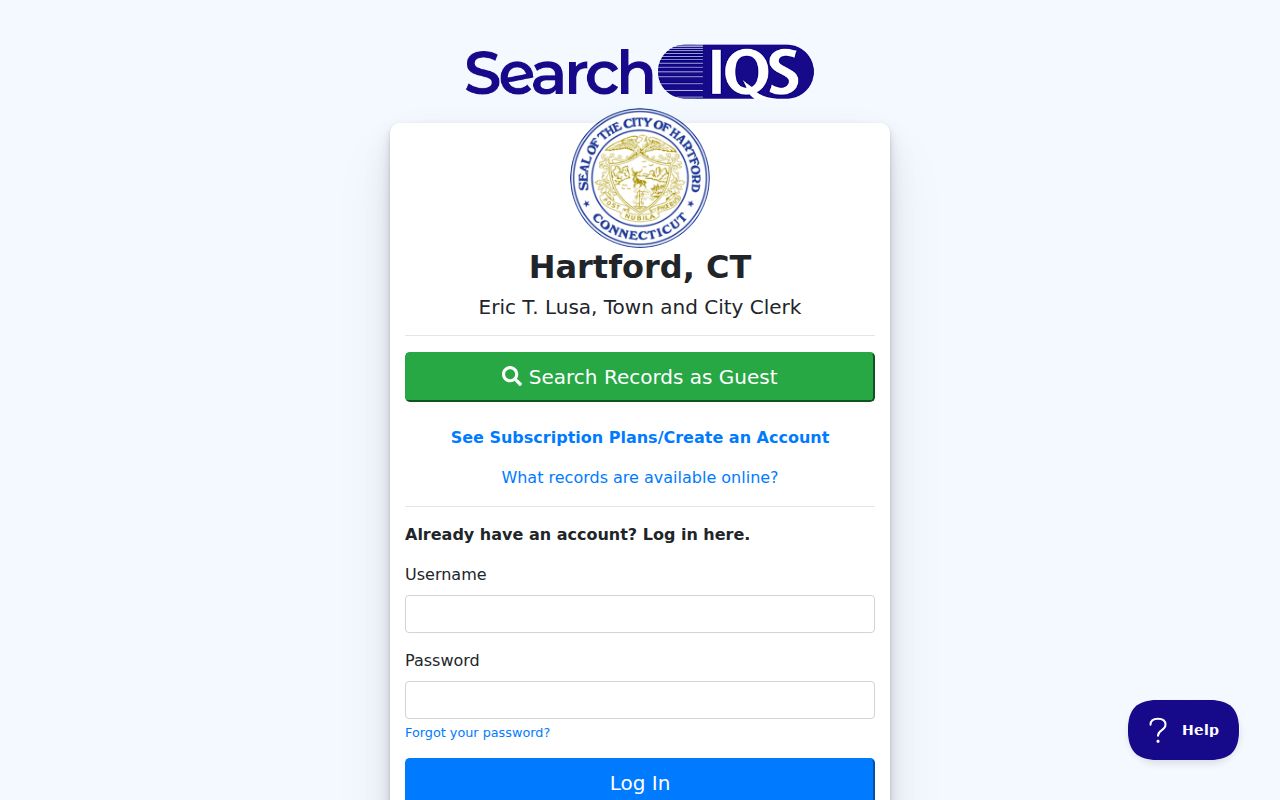
The image shows the portal's entry screen. The published coverage dates, not the login itself, decide how far a former-owner chain can reach online.
Use Name Variants Without Leaving the Parcel
Names shift over time. A prior owner of record may appear under initials, a maiden or former surname, an estate name, trustees, or a business entity. The recorder may not use a single consistent spelling. Run each exact recorded form through the property search. Then anchor every hit with the legal description, the prior deed citation, or a map reference. A matching name by itself proves little in Hartford County property records.
Local collections can decode the older forms. The Hartford History Center and the New Britain Local History Room hold directories, maps, and newspapers. These link a name variant to a place or translate an outdated street number. A Sanborn sheet may reveal an old address range or a building footprint. None of these sources carries title. So treat each clue as a pointer toward the next municipal deed or probate instrument.
Track the land, not just the names. At every step, note whether the deed covered the whole parcel, a partial interest, a condominium unit, or land later altered by merger or split. That habit keeps a plausible owner list from hardening into a false chain of title.
Know the Online Depth of Hartford County Former Owners
Online depth varies by town and collection. Hartford's ordinary index, Hartford maps, New Britain's current index, and its HLR volumes all start on different dates. No single endpoint covers every town's deed records across Hartford County. When the web trail runs out, go to the municipal clerk first. A library or the state archive can supply context from there.
Lawful use. Research previous owners for house history, estate work, title diligence, or map questions. Never use the chain to track, expose, or harass a living person.